
See like a champion – with Tobii
See the track like a champion
Analysis of ocular movements in real and simulated environments
in collaboration with Tobii
One of the fundamental principles of driving technique states that the car goes where the eyes go. The correct management of visual attention during a corner approach, turn-in and mid-corner phase is a key factor in performance.
Every trajectory is born from the eyes. Every decision takes shape in a fraction of a second, in a precise point of the track that the driver chooses to look at.
Great drivers do not see more.
They see better.
And above all, they see earlier.
The driver must be able to identify and process, in the correct temporal sequence, braking references, apex, exit trajectory, dashboard information, and mirrors. This process must happen automatically, with minimal cognitive load and maximum perceptual efficiency.
In top-level drivers, these dynamics appear natural. In reality, they are the result of:
-
High concentration capability
-
Extremely fast saccadic eye movements
-
High-speed visual information processing
-
Well-developed perceptual anticipation skills
For most amateur or developing drivers, these abilities must be acquired, trained and structured.
From this awareness, the project developed with Dominik Dedic – Junior Performance Development Engineer at Sauber Motorsport, Tobii and Skydrive was born.
A project that brings together high-level motorsport, state-of-the-art eye tracking technology, advanced simulation and human performance research.
Project objectives
The research project is focused on the quantitative analysis of drivers’ eye movements in different operational contexts.
The main objectives are:
-
To characterize the visual behavior of professional drivers
-
To compare it with that of amateur and non-professional drivers
-
To identify recurring patterns, significant differences and areas for improvement
-
To lay the foundations for the development of eye-tracking-based training tools
By analyzing the gaze, we access the most intimate part of driving: the decision-making process. And above all, thanks to Tobii wearable eye trackers, gaze becomes data.
No longer a feeling, but something quantifiable, measurable, analyzable and therefore trainable and improvable.
:quality(80))
Methodology
To ensure data validity, the project is based on three key elements:
-
Real environment – On-track testing
-
High-fidelity virtual environment – Avehil by Skydrive simulator
-
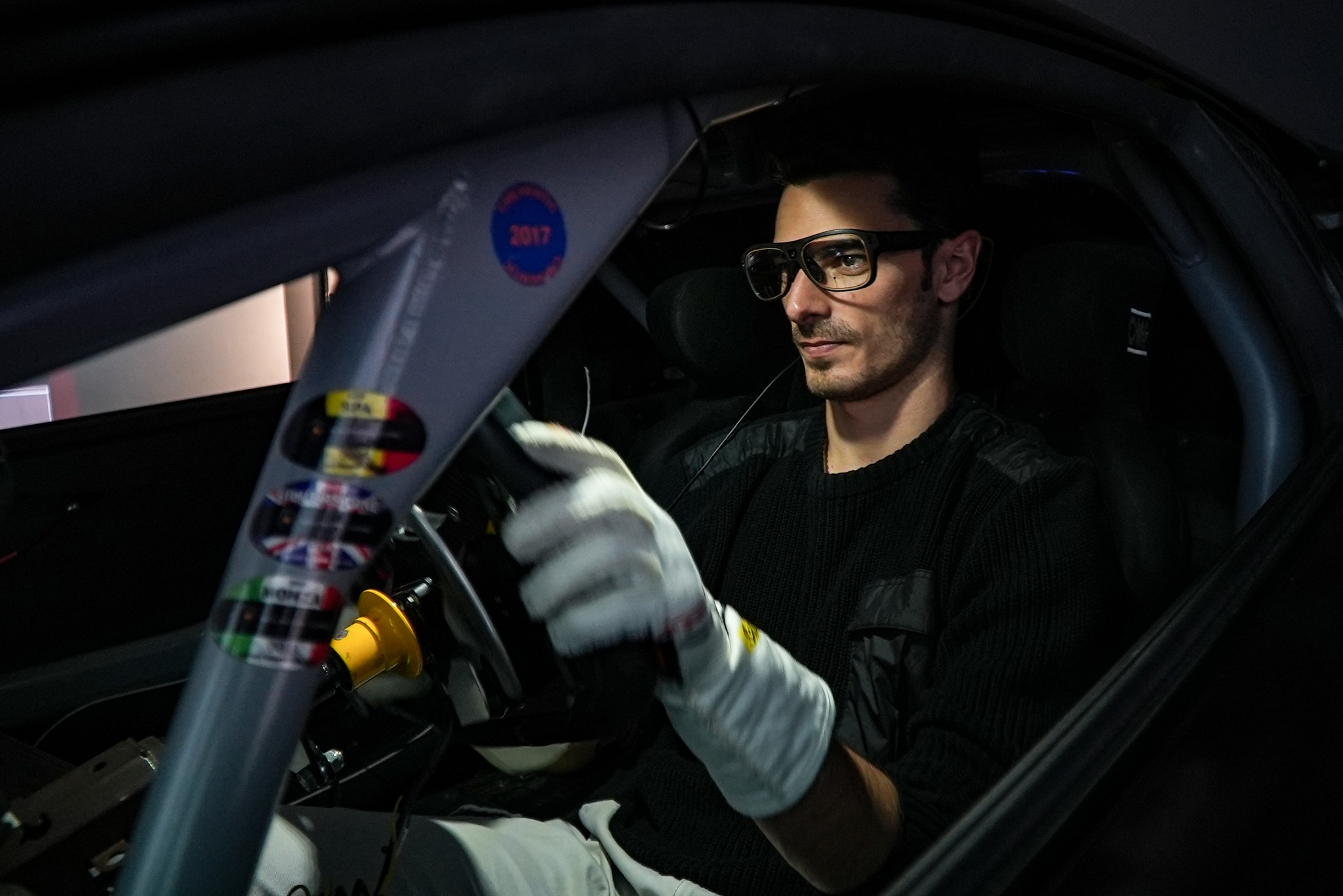
High-performance eye tracking system – Tobii Pro Glasses 3
This is where Skydrive’s contribution becomes crucial. In addition to providing the Avehil simulation structure, which is cutting-edge in many aspects relevant to this research, Skydrive also has the expertise, know-how and motorsport network required to organize on-track tests with different cars and drivers, on different circuits.
Eye tracking technology – Tobii
All of this would be meaningless without the right measurement tool.
A high-performance wearable eye tracker was required, capable of being worn under a racing helmet and operating reliably in extreme conditions.
Tobii Pro Glasses 3 was selected for:
-
High sampling frequency
-
High gaze detection accuracy
-
Signal stability under vibration
-
Reliability in low-light conditions
-
Compatibility with highly dynamic, high-acceleration environments
These characteristics allowed the acquisition of reliable ocular data both on track and in simulation.
On-track testing
1 – Barcelona – Ferrari Challenge Europe | Ferrari 296 Challenge | AM Driver
During Friday FP1 of the Ferrari Challenge Europe race weekend, a Bronze driver wore Tobii Pro Glasses 3 for data collection in real competitive conditions. This was the first dynamic test and allowed the collection of a significant amount of data.
:quality(80))
2 – Imola – Italian GT Championship | Ferrari 296 Challenge | PRO-AM Crew
PRO: Matteo Cairoli
AM: Bronze driver
The Imola circuit, characterised by blind corners, elevation changes and complex braking zones, provided an ideal context to analyse visual management in high-complexity situations. This configuration also allowed direct comparison between a reference driver and a developing driver.
:quality(80))
3 – Portimão – LMP2 Oreca-Gibson | PRO-AM Crew
PRO: Alessio Rovera – Official Ferrari Competizioni Driver
PRO: Matthieu Vaxiviere – Former Official Alpine Driver
AM: François Perrodo – Bronze Driver
The combination of an extremely high-downforce prototype and a highly technical track made it possible to analyse visual behaviour under high perceptual and decisional demand. The possibility to alternate drivers of different performance levels in the same car provided highly comparable data sets.
Simulation testing – Avehil by Skydrive
In parallel, test sessions were designed and conducted on the Avehil by Skydrive simulator, dedicated to GT simulations.
The simulator was designed with a clear philosophy: Avoid conflict between visual and vestibular systems, drastically reducing nausea and fatigue.
This made it possible to acquire ocular data in conditions extremely close to real driving.
The value of simulation in research
The simulator made possible what is impossible on track:
-
Testing multiple circuits in the same session (Barcelona, Imola, Portimão)
-
Direct comparison between professionals, AM drivers, e-racers and novices
-
Repeatability of conditions
-
Isolation of specific variables
Once again, the quality of Tobii Pro Glasses 3 proved to be decisive: The lighting inside the simulator cockpit is significantly lower than in a real race car. Only an eye tracking system of this level could guarantee reliable data.
Giardina: “The information reaching the brain from the eyes and the vestibular system is coherent. The result is an immersive environment that allows us to analyze visual behavior in a way that is extremely close to reality. And this is exactly what we observed during the tests.”
Elevating the visual skills of performance drivers
Talent is not enough. And experience alone is no longer sufficient. The future of performance lies in awareness and data. Training the gaze is revolutionary.
Our goal is to create the first training system that teaches drivers:
Where to look.
When to look.
How to anticipate.
To improve, it is not enough to copy champions. You must learn to think and act like champions.
Summary
We are not building a product. We are building a new way of seeing driving.
When you change the way you look, you change the way you drive. And when you change the way you drive, you change the result.